
When the government or a contractor needs temporary access to your property for construction, the easement can affect driveways, landscaping, parking, business access, drainage, and restoration. Before you sign or accept compensation, have the temporary easement terms reviewed.
A temporary construction easement may only last for a limited period, but it can still affect how your property is used during the project. Contractors may need access for equipment, staging, grading, driveway work, sidewalk work, drainage work, or road construction.
The key issues are where they can work, how long they can stay, what they are allowed to do, and what must be repaired or restored when the work is finished.
Before signing, the temporary easement should clearly explain the work area, time period, contractor access, restoration duties, and compensation.
The easement should identify the exact temporary work area, the expected start and end dates, and what parts of the property may be used.
Contractors may need access for equipment, materials, grading, trenching, fencing, staging, driveway work, or temporary traffic control.
The document should explain what must be restored, who is responsible for repairs, and what happens if the work causes damage.
A temporary construction easement should identify the specific part of the property that may be used during construction. The more vague the work area, access route, or restoration language is, the more room there may be for disputes later.
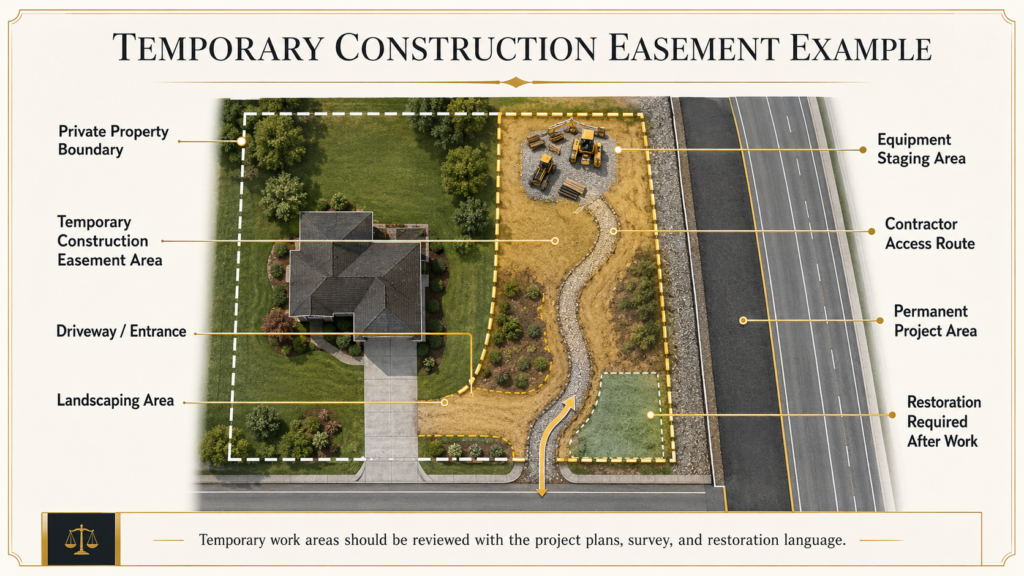
A temporary construction easement should be reviewed together with the project plans, survey, access route, construction limits, and restoration language.
A temporary construction easement may allow contractors to use part of your property while a public project is being built. Even if the easement is temporary, the work can affect access, landscaping, parking, drainage, and normal use of the property.
Construction may affect driveways, curb cuts, sidewalks, parking areas, or entrances used to access the property.
Contractors may seek to store machinery, dirt, gravel, pipes, barriers, signs, fencing, or other materials on part of the property.
Grass, trees, shrubs, irrigation, fencing, retaining walls, or other improvements may be disturbed during the work.
Construction activity may affect slopes, drainage patterns, soil conditions, erosion, or how water moves across the property.
Work near the property may create noise, dust, vibration, traffic, temporary fencing, cones, and other construction-related disruption.
Part of the property may be difficult or impossible to use while contractors are working, storing materials, or limiting access.
A temporary construction easement should not leave the property owner guessing what happens after construction is complete. The easement should explain what must be restored, who is responsible for the work, and what happens if the property is damaged.
Construction work can disturb more than the surface of the property. Heavy equipment, grading, trenching, fencing, and staging can affect soil conditions, drainage, pavement, landscaping, and access.
The temporary easement should make clear whether the property must be returned to its prior condition, what standard applies, and how unresolved damage will be handled.
Restoration language should be specific. Vague promises to “restore the property” may not be enough.
The easement should address regrading, sod, seed, shrubs, trees, irrigation, mulch, and disturbed yard areas.
Any damaged driveway, curb, sidewalk, parking area, or paved surface should be repaired or replaced as required.
The property should not be left with new drainage problems, erosion, standing water, slope changes, or unstable soil.
Fences, signs, mailboxes, retaining walls, lighting, and other improvements should be addressed if they are removed or damaged.
The easement should explain who is responsible if contractors cause damage outside the temporary work area.
The owner should understand when restoration must be completed and how disputes over incomplete restoration will be handled.
Some temporary construction easements are written broadly enough to create problems later. Before signing, the easement should be reviewed for vague work areas, open-ended access, unclear restoration duties, and language that gives contractors more rights than necessary.
A temporary easement should say when the right begins, when it ends, and what happens if the project is delayed.
The easement should identify the exact area contractors may use instead of allowing access across more of the property than necessary.
Language that allows unrestricted entry, staging, equipment storage, or access outside the work area should be reviewed carefully.
The easement should explain what must be repaired, restored, replaced, or regraded after construction is finished.
The document should explain who is responsible if contractors damage landscaping, pavement, drainage, fencing, or improvements.
Compensation should be reviewed in light of temporary loss of use, access disruption, restoration issues, and damage risk.
Before signing a temporary construction easement or accepting compensation, make sure you understand exactly what part of your property may be used, how long the work may last, what the contractor may do, and what must be restored afterward.
Compare the easement language to the project plans, survey, construction limits, and any map showing where contractors may work.
The easement should explain when temporary access begins, when it ends, and what happens if construction is delayed or extended.
Take photos and videos of driveways, landscaping, fences, drainage areas, pavement, entrances, and any improvements before work begins.
Make sure restoration duties, damage responsibility, temporary loss of use, access disruption, and compensation are reviewed before signing.
Before you sign or accept compensation, make sure the temporary construction easement clearly explains the work area, time period, contractor access, restoration duties, damage responsibility, and payment terms.
Work area and access route
Start date and end date
Driveway or entrance disruption
Restoration and damage repair
Compensation for temporary use