
When a public project affects commercial property, the impact may go beyond the land taken. Access, parking, visibility, deliveries, signage, tenant use, and daily business operations can all affect the value of the remaining property.
A partial taking from a business property may look small on paper, but the effect can be larger if the project changes how the property functions. Parking, entrances, loading areas, signage, visibility, tenant access, and internal circulation may all matter.
The key question is whether the remaining property can continue supporting the same commercial use after the project is complete.
For commercial properties, value is often tied to function. A small taking can become a larger problem if it affects how the business operates.
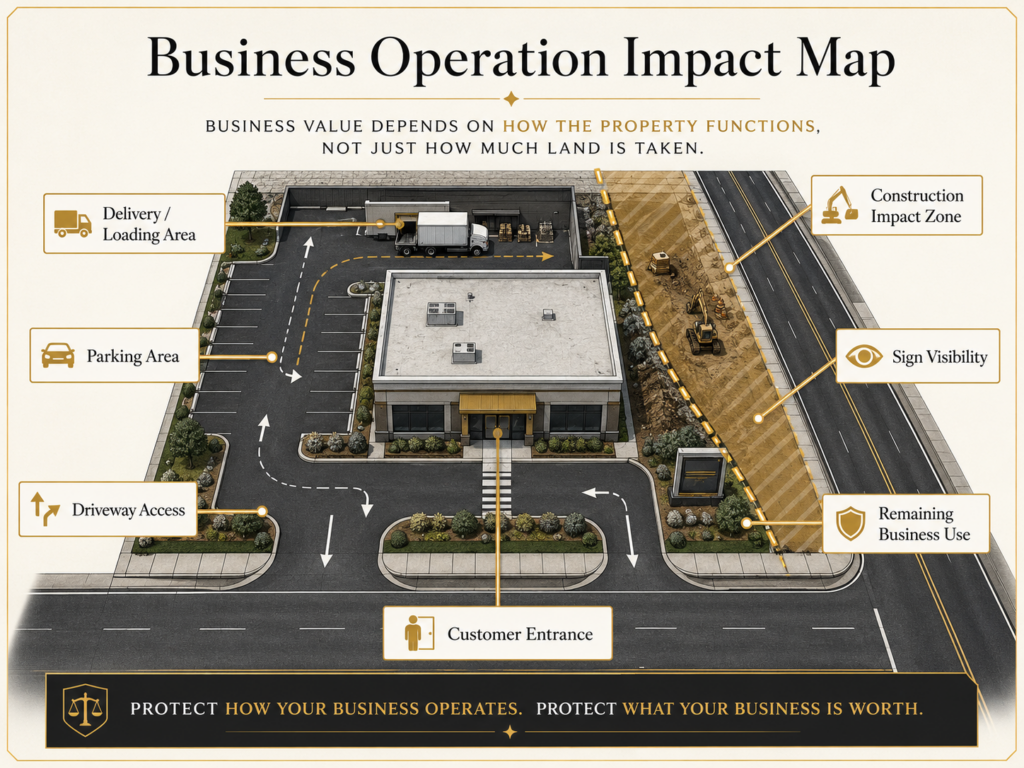
Business property impacts should be reviewed by looking at access, parking, visibility, signage, deliveries, loading areas, tenant use, and whether the remaining property can still operate effectively.
A public project can affect more than the land shown on the plans. For commercial property, the impact may depend on how the project changes customer access, parking, visibility, deliveries, tenant use, and the value of the remaining property.
A project may make it harder for customers, tenants, or visitors to reach the business.
A taking may reduce parking spaces, drive aisles, loading areas, or room for vehicles to maneuver.
Road changes, grade changes, barriers, or sign relocation may affect how visible the business is from the road.
Commercial properties may be affected if trucks, vendors, or delivery vehicles can no longer enter, turn, load, or unload efficiently.
A project may affect tenant access, lease value, business layout, or how the property can be used.
If the remaining property is less functional, less visible, or less convenient, its market value may be affected.
Business property impact should be reviewed as a complete operational picture, not only as a measurement of square footage taken.
For many commercial properties, value depends on whether customers can find the business, enter the property, park, and reach the storefront without difficulty. A public project can affect these customer-facing features even when the business remains open.
A business property may lose value if customers have a harder time seeing the location, turning into the site, finding parking, or walking safely from the parking area to the entrance.
These issues are especially important for retail, restaurants, medical offices, service businesses, shopping centers, and tenant-occupied commercial properties.
The impact is not limited to the land taken. The question is whether the project changes how customers actually use the property.
Road changes, grade changes, barriers, or sign relocation may affect visibility from the roadway.
A moved, narrowed, or restricted entrance can make customer access less direct or less convenient.
A taking may remove parking spaces, reduce drive aisles, or make the parking lot harder to use.
Sidewalk changes, construction limits, parking changes, or circulation problems may affect the path from parking to the business entrance.
Customer-facing impacts should be reviewed together with the site plan, parking layout, signage, driveway design, traffic pattern, and the business use of the property.
Commercial property value may depend on more than customer access. Many businesses also need delivery vehicles, vendors, service providers, employees, and emergency vehicles to move through the site safely and efficiently.
A road project may reduce the space available for trucks, loading areas, drive aisles, dumpsters, service vehicles, or internal circulation. These changes can affect whether the property still supports the same commercial use.
For some businesses, losing a loading area, truck turn path, or service route can be more damaging than losing a small strip of land.
The key issue is whether the remaining site still works for the business, tenants, deliveries, and service access.
A taking may reduce the space trucks need to enter, turn, back up, load, unload, or leave the property safely.
Loading zones, delivery doors, docks, dumpsters, or service areas may be affected by new construction limits or reduced site depth.
Vendors, delivery vehicles, contractors, and suppliers may have a harder time reaching the property or completing regular service.
The project may affect how vehicles move inside the property, including parking lot circulation, drive aisles, and turnaround space.
Fire, EMS, trash collection, maintenance, utilities, and other service vehicles may need enough space to reach the property safely.
Commercial property value may depend on more than the building and land. Tenant use, lease value, rent potential, vacancy risk, parking, visibility, access, and site functionality can all affect the value of the remaining property.
A commercial property may lose value if the project makes it harder for tenants to operate, customers to reach the business, delivery vehicles to use the site, or future tenants to justify the same rent.
Even when the building remains, the remainder property may be affected if the project changes the economic usefulness of the site.
The question is whether the remaining property can still support the same tenant use, rent, operations, and marketability after the project.
A project may affect how tenants use the property, including access, parking, signage, loading, deliveries, or customer flow.
If the property becomes less functional or less convenient, the change may affect rent potential, renewal value, or tenant expectations.
A property that is harder to access, park at, service, or operate may be harder to lease or keep occupied.
Buyers, tenants, and appraisers may view the property differently if the taking reduces visibility, convenience, circulation, or business usability.
If the project affects rent, occupancy, tenant use, or the property’s ability to support business operations, the value of the remainder may be affected.
Tenant and income impacts should be reviewed with the leases, property use, site layout, access changes, parking impact, and the value of the remaining commercial property.
Business property impacts should be reviewed with more than the offer letter. The project plans, site layout, parking design, access changes, lease information, and business use of the property may all affect the value of the remaining property.
A taking may appear limited on paper, but the supporting documents may show changes to parking, access, signage, loading areas, circulation, visibility, tenant use, or the remaining property’s ability to support the same commercial use.
These documents show what land is being affected and how the property layout may change after the project.
Right-of-way plans
Site plan or survey
Driveway and access plans
Grading and drainage plans
These documents help show whether the remaining site still works for customers, parking, deliveries, loading, and daily business use.
Parking layout
Loading and delivery areas
Signage and visibility plans
Construction staging plans
These documents help evaluate whether the taking affects rent, tenant use, occupancy, marketability, or the value of the remaining property.
Appraisal or offer letter
Lease documents
Tenant or business use information
Before-and-after property layout
Can customers still reach the business?
Does parking still work?
Can deliveries still operate?
Is the remaining property less valuable?
A taking from business property may create a larger value issue when it affects how the site attracts customers, supports operations, serves tenants, or remains marketable after the project is complete.
Impact Area
Warning Signs
Why It Matters
Customers have a harder route, the entrance is moved or narrowed, or direct access becomes less convenient.
The property may become harder for customers, tenants, visitors, or service providers to reach.
Parking spaces are lost, drive aisles are reduced, or vehicles have less room to maneuver.
The remaining site may become less functional for customers, employees, deliveries, or tenants.
Sign visibility is reduced, frontage changes, grade changes affect visibility, or barriers block the business from view.
Reduced visibility can affect customer traffic, marketability, tenant value, and the usefulness of the commercial frontage.
Deliveries, loading areas, truck turning movements, dumpsters, or service access are limited.
The property may no longer support the same business operations, tenant needs, or commercial use.
Construction blocks entrances, affects parking, limits access, or interferes with regular operations.
Temporary disruption can still affect business use, tenant expectations, and the practical value of the property during the project.
Tenant access is disrupted, the property becomes harder to lease, or the site no longer supports the same commercial use.
If the property becomes harder to operate, lease, sell, or appraise, the value of the remaining property may be affected.
The key question is whether the remaining property can still function as a valuable commercial site after the taking, construction, and roadway changes are complete.
Before signing or accepting compensation, have the taking, access changes, parking impact, signage issues, delivery access, tenant concerns, and remainder property value reviewed. A business property may lose value when the project affects how the site operates, not just how much land is taken.
Access and driveway changes
Parking and circulation impact
Parking and circulation changes
Delivery and loading access
Tenant, lease, and income impact
Remainder property value
Business property impacts can involve more than the amount of land taken. These questions address common issues involving access, parking, visibility, deliveries, tenants, leases, income, and the value of the remaining commercial property.
Yes. A taking may appear small on paper, but it can still affect how the property functions if it changes access, parking, visibility, signage, loading areas, deliveries, tenant use, or customer flow.
Important issues may include customer access, parking loss, driveway changes, visibility, signage, delivery access, truck circulation, construction disruption, tenant use, lease value, and the value of the remaining property.
Yes. Parking can be important to the value and usability of a commercial property. If a project reduces parking spaces, drive aisles, loading areas, or circulation, the remaining property may be less useful or less marketable.
Yes. Commercial property value may depend on whether customers can see the business from the road. Road widening, grade changes, barriers, sign relocation, or frontage changes may affect visibility and marketability.
Delivery and loading issues can be important for business properties. If trucks, vendors, service vehicles, or delivery drivers can no longer enter, turn, load, unload, or exit efficiently, the property may no longer support the same commercial use.
Yes. Tenant use, rent potential, lease value, vacancy risk, and marketability may be relevant when a public project affects how the property operates. A property that becomes harder to lease, operate, or sell may have a reduced remainder value.
Important documents may include right-of-way plans, site plans, surveys, driveway and access plans, parking layouts, signage plans, grading and drainage plans, construction staging plans, leases, appraisal materials, and before-and-after property layouts.
Before accepting compensation or signing documents, the business property impact should be reviewed. The offer may not fully account for access changes, parking loss, visibility issues, delivery problems, tenant concerns, or reduced remainder value.