
Road projects can change how people enter, exit, park, and use private property. Even when only part of the property is taken, driveway changes, curb cuts, medians, turn restrictions, or access limitations can affect property value and daily use.
A property’s value can depend heavily on how vehicles, customers, tenants, residents, deliveries, and emergency services reach it. A driveway may still exist, but access can still be meaningfully changed.
A road project may move an entrance, narrow a curb cut, add a median, restrict turns, change the driveway grade, reduce visibility, or make the property harder to use.
The question is not only whether access remains. The question is whether the remaining access is reasonable, usable, safe, and consistent with the property’s use.
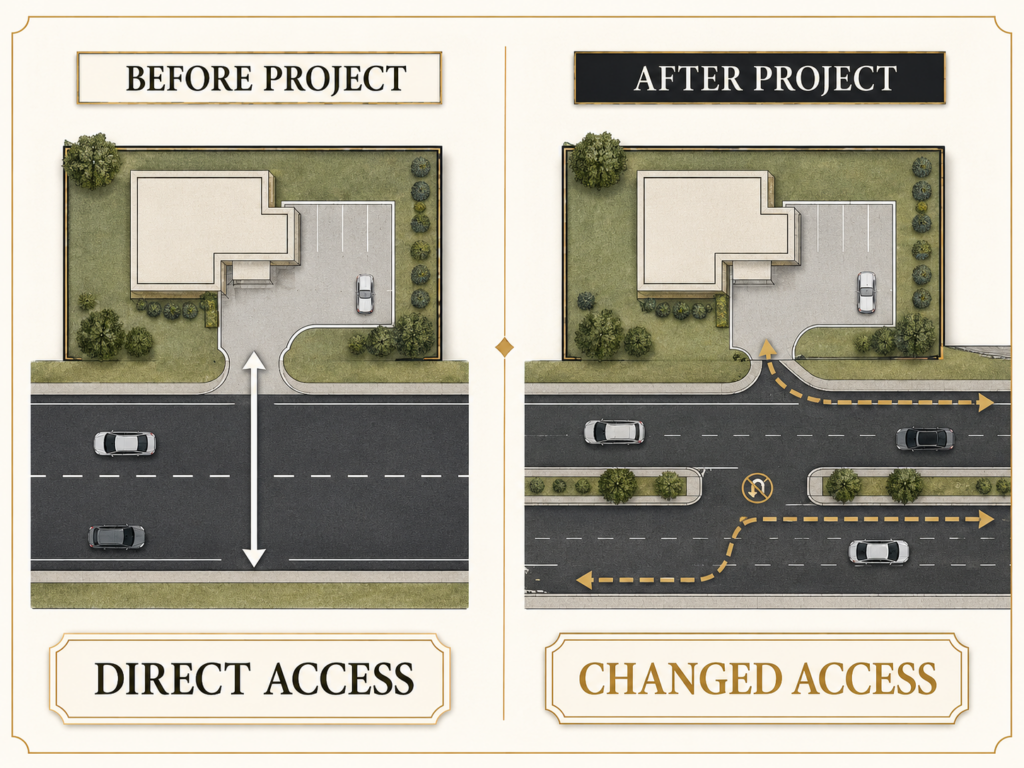
Access should be reviewed by looking at driveway location, turning movements, medians, grade changes, parking, circulation, and how the remaining property can actually be used.
Access problems are not always obvious from the offer letter alone. A road project may leave a driveway in place but still change how safely, conveniently, or effectively the property can be reached.
A narrowed curb cut or entrance may make it harder for larger vehicles, trailers, customers, tenants, or emergency vehicles to enter and exit safely.
A new median, turn lane, or traffic pattern may prevent left turns, require U-turns, or make the route to the property less direct.
A changed driveway grade can affect vehicle clearance, drainage, safety, and whether certain vehicles can use the entrance comfortably.
Road widening may reduce parking, loading areas, internal drive aisles, turnaround space, or room for vehicles to maneuver.
For business properties, access changes can affect customer convenience, deliveries, truck turning movements, visibility, tenant use, and overall marketability.
Access changes can affect value because they change how the remaining property functions. A property may still be reachable, but the access may be less convenient, less safe, less visible, or less useful for the property’s actual purpose.
Access
+
Visibility
+
Turning Movement
+
Parking
+
Site Circulation
=
Property Function
A property may still have a driveway, but if the driveway becomes harder to use, less visible, or less convenient, the remaining property may not function the same way it did before the project.
The issue is not just whether access exists. The issue is how the access change affects the property’s use and value.
A longer or more difficult route can make the property less convenient for residents, customers, tenants, visitors, or service providers.
Narrower driveways, tighter turns, and new medians can make entering and leaving difficult, especially for larger vehicles.
Lost spaces and reworked drive aisles can disrupt how vehicles move, park, load, and turn on the property that remains.
Poor visibility and awkward access can deter passing customers, weakening the site’s value for retail, service, or rental use.
If the property becomes harder to reach, harder to use, or less convenient, buyers, tenants, or appraisers may view it differently.
The same road project can affect different properties in different ways. A driveway change that creates inconvenience for a homeowner may create a larger operational or marketability problem for a commercial property.
Access changes may affect how safely and conveniently residents, guests, service providers, and emergency vehicles can enter and leave the property.
For businesses, access changes can affect customer traffic, deliveries, tenant use, visibility, truck circulation, and the property’s overall marketability.
Access changes should be reviewed with the actual roadway plans, driveway plans, grading plans, and traffic-control documents. These materials can show whether the property will still have reasonable access after the project is complete.
A property owner may be told that access will remain, but the detailed plans may show a driveway shift, grade change, median restriction, reduced parking, or a more difficult route into the property.
Reviewing the plans helps determine whether the remaining access is still reasonable, safe, visible, and consistent with how the property is actually used.
Where will the driveway be?
How will vehicles turn?
Will parking be reduced?
Will the grade or slope change?
Show whether the driveway will be moved, narrowed, steepened, flattened, reconstructed, or tied into the road differently.
Show the location, width, turning radius, and entrance design for vehicles entering and exiting the property.
Show whether left turns, direct access, U-turns, or traffic movements will be restricted after the project.
Show slope changes, drainage changes, elevation changes, erosion issues, or water flow near the driveway.
Show whether the project affects parking spaces, drive aisles, loading areas, turnaround space, or internal traffic flow.
Show temporary access issues during construction, including lane closures, blocked driveways, detours, or temporary entrances.
Not every road project creates a compensable access issue, but certain changes should be reviewed carefully. If the project makes the property harder to enter, harder to leave, less visible, less convenient, or less usable, the access change may affect the value of the remaining property.
The issue is not only whether the property still has a driveway. The issue is whether the remaining access is reasonable for the property’s actual use after the project is complete.
A driveway, entrance, or curb cut may technically remain, but the property can still be affected if the access becomes less safe, less direct, less visible, or less practical.
Access changes should be reviewed in connection with the property’s use, traffic movements, driveway design, and the value of the remaining property.
A driveway is moved or narrowed
A new median blocks direct access
Left turns are eliminated
The entrance becomes harder to see
Parking or turnaround space is reduced
Large vehicles can no longer enter safely
The driveway grade changes significantly
Drainage near the entrance changes
A business entrance becomes less convenient
The remaining property is harder to use or sell
Before signing or accepting compensation, have the driveway plans, access changes, traffic patterns, and remainder property impact reviewed. A property may still have access, but the access may not function the same way after the project is complete.
Driveway location and design
Median or turn restrictions
Parking and circulation changes
Commercial or residential use impacts
Remainder property value
Property access issues can be difficult to evaluate from an offer letter alone. These questions address common concerns about driveway changes, medians, turning restrictions, and access impacts after a road project.
A road project may involve driveway relocation, reconstruction, narrowing, grading changes, or new curb cut design. The impact should be reviewed with the project plans to determine how the change affects access, safety, and property use.
Not always. The issue is not only whether access remains, but whether the remaining access is reasonable, usable, safe, and consistent with the property’s use after the project is complete.
A new median, turn lane, or traffic pattern may affect how vehicles reach the property. If direct access is reduced, left turns are eliminated, or the route becomes less convenient, the change may affect the value or use of the remaining property.
A moved or narrowed driveway can affect vehicle turning movements, parking, delivery access, emergency access, customer access, and internal circulation. The new driveway location and design should be reviewed carefully.
Yes. For residential properties, access changes may affect safety, parking, guests, service vehicles, emergency access, slope, and drainage. For commercial properties, access changes may affect customers, deliveries, truck movements, visibility, tenant use, and marketability.
Important documents may include driveway plans, roadway plans, curb cut details, grading and drainage plans, median and turn-lane plans, traffic-control plans, parking layouts, and before-and-after access routes.
Yes. A change in driveway slope, vehicle clearance, drainage, or water flow near the entrance can affect safety, usability, maintenance, and property value.
Before accepting compensation or signing documents, the driveway design, traffic patterns, access route, parking impact, and remainder property value should be reviewed. A property may still have access, but it may not function the same way after the project.